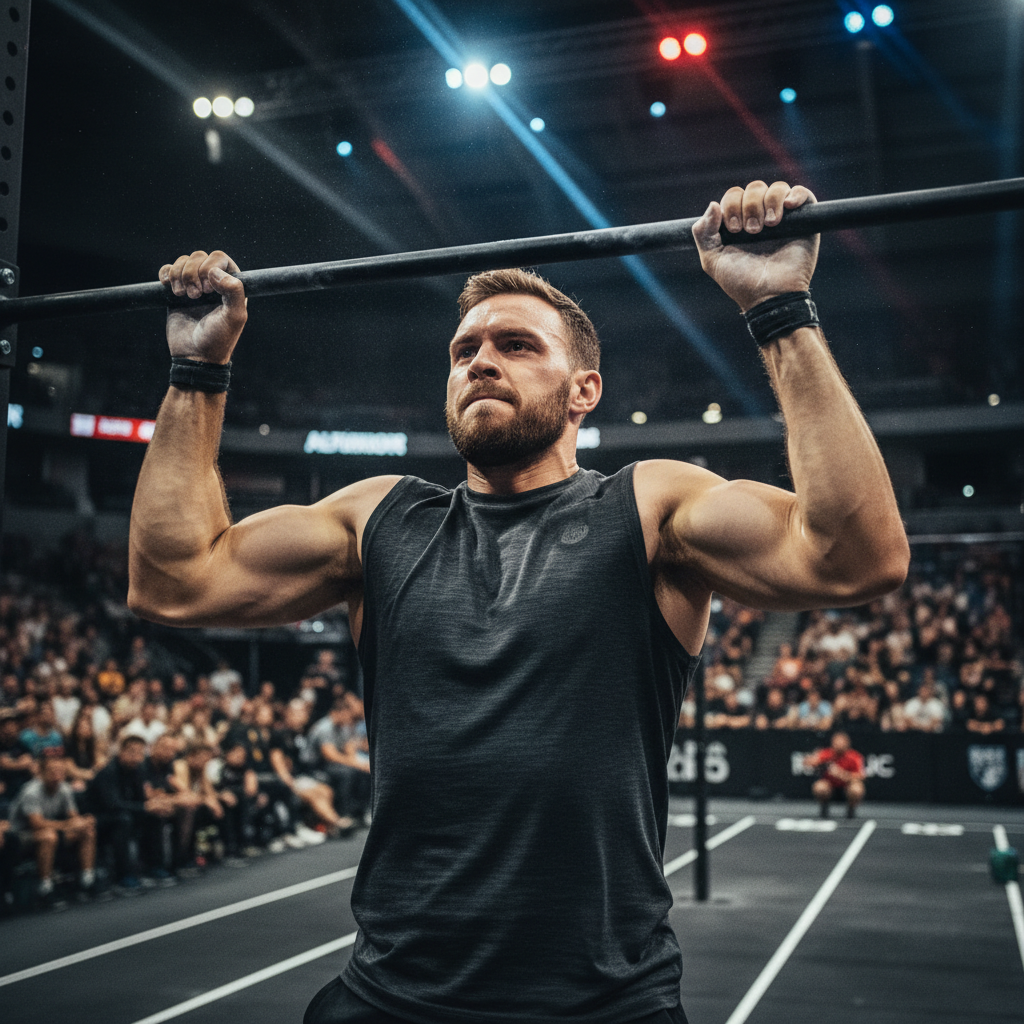
Patrick Vellner: One Last Shot at the Title
The Canadian veteran is still hunting the one thing that has eluded him. Is 2026 his year?
The Weight of Almost
There is a particular cruelty reserved for athletes who are great but not quite greatest. Patrick Vellner knows this cruelty intimately. He has stood on the CrossFit Games podium five times. He has been the bridesmaid, the groomsman, the perennial contender who makes the wedding party but never catches the bouquet. At 33 years old, the window is not just closing — it is making that sound windows make right before they slam shut.
Vellner's résumé reads like a Hall of Fame case in any other sport. Second place in 2018. Third in 2019. Third in 2022. Consistently among the top five fittest men on Earth for the better part of a decade. In any generation that did not include Mat Fraser and then Justin Medeiros, Vellner would almost certainly have a title.
But "almost certainly" does not count in CrossFit. The Fittest on Earth title is binary. You either win it or you do not.
"I've never once thought about quitting because of the losses. I think about quitting because of my body. The losses just mean I haven't done enough yet." — Patrick Vellner
The Chiropractor Who Could
Vellner's backstory adds a layer of improbability to his career. He holds a Doctor of Chiropractic degree and maintained a clinical practice during his early competitive years. While rivals trained full-time, Vellner was adjusting spines in the morning and doing intervals in the afternoon.
The fact that he reached the podium while splitting his focus speaks to a natural athletic talent that borders on absurd. A former CIS (Canadian university) gymnast, Vellner brought a movement quality and body control that set him apart from the barbell-first generation of CrossFit athletes. His gymnastics are efficient. His barbell work is technical. His engine is relentless.
What he has lacked — and what his critics have pointed to for years — is the ability to seize the moment when the title is on the line. The big event, the decisive workout, the Sunday afternoon at the Games when champions separate from contenders. Vellner has always been there. He has never quite been there.
2025: The Season That Stung
The 2025 CrossFit Games should have been Vellner's best opportunity. The field, while deep, lacked a dominant favourite. Medeiros had shown signs of vulnerability. Roman Khrennikov was strong but inconsistent on gymnastics-heavy days. The door was open.
Vellner walked through it — partially. He led after Day 1. He held a podium position through Day 2. And then, as has happened before, the final events exposed the gap between being close and being champion. A 15th-place finish on the final event dropped him to fourth overall, missing the podium by a margin that will haunt his off-season.
Fourth is the cruelest place in sport. Third gets a medal. Fourth gets a handshake and a long flight home.
The Physical Reality of 33
CrossFit is not kind to aging athletes. The sport demands peak output across every energy system, every movement pattern, every loading scheme. It rewards the athlete who has no weakness — and time, inevitably, creates weaknesses.
What the Data Shows
The historical data on CrossFit Games champions is unambiguous. The average age of a male Games champion is approximately 27 years old. Only Rich Froning won after 30, and he transitioned to team competition shortly after. The sport's physical demands — particularly the recovery demands of multi-day competition — favour athletes in their mid-to-late twenties.
At 33, Vellner is not ancient. He is, by Games standards, old. His recovery between events takes longer. His peak power output, while still elite, has declined from its 2019 highs. His injury risk increases with each training cycle.
The counter-argument, which Vellner himself has made, is that experience compensates for physical decline. He knows how to pace a competition. He knows when to push and when to survive. He has made every mistake a Games athlete can make, and he has learned from each one.
The question is not whether Vellner is still elite. He demonstrably is. The question is whether elite is enough when the margin between first and fourth is measured in seconds and single reps.
The Training Evolution
Vellner's training approach has evolved significantly over the past two years, reflecting both the reality of aging and the lessons of near-misses.
He has shifted toward higher-quality, lower-volume sessions, prioritising recovery and intensity over raw training hours. His programming, guided by coach Adam Neiffer, emphasises:
- ▸Heavy strength work to maintain the absolute power that underpins Games performance
- ▸Sprint interval training to preserve the top-end speed that separates podium from pack
- ▸Dedicated mobility and recovery protocols including cold exposure, manual therapy, and sleep optimisation
- ▸Strategic deload periods that would have been unthinkable in his younger, more-is-more training days
- ▸Mental performance coaching to address the psychological weight of competing as the underdog favourite
The approach is rational. Whether it is enough to overcome the physics of aging in an absolute-performance sport remains the central question of Vellner's 2026 campaign.
The Injury Ledger
Every long-career athlete carries an injury history, and Vellner's is substantial. Shoulder issues, back tweaks, and the accumulated wear of a decade of elite competition have left their mark. He has managed these injuries intelligently — his chiropractic background gives him an advantage in understanding and treating his own body — but management is not elimination.
The risk is that an injury during the Games itself could turn a championship run into a withdrawal. Vellner has never pulled out of a Games competition, but the probability increases with each passing year. One awkward landing on a box jump, one tweak on a heavy snatch, and the dream is over.
The Competition: Who Stands in the Way
Winning the CrossFit Games in 2026 requires navigating a field that is deeper, younger, and more athletic than at any point in the sport's history. Vellner's path to the title runs directly through several formidable opponents.
Justin Medeiros: The Incumbent
Medeiros has won the Games twice and carries the quiet confidence of an athlete who knows what it takes to win the big one. At 25, he is in his physical prime. His weaknesses — limited gymnastics ceiling, occasional pacing errors — are well-known but have not prevented him from winning when it mattered.
For Vellner, Medeiros represents the archetype he must overcome: younger, physically gifted, and psychologically unburdened by years of near-misses.
Roman Khrennikov: The Wildcard
Khrennikov has been one of the most dominant Semifinal performers in CrossFit history but has yet to translate that dominance to the Games. His combination of raw strength and engine capacity makes him dangerous on any workout, but his gymnastics — particularly high-skill movements — remain a potential vulnerability.
If Khrennikov solves his gymnastics problem, he may be the most physically talented athlete in the field. Vellner's advantage over him is consistency and composure, traits that matter enormously over a multi-day competition.
Brent Fikowski: The Mirror
Fikowski is, in many ways, Vellner's competitive doppelgänger: a Canadian veteran with multiple podium finishes and no title. At 32, Fikowski faces the same age-related challenges as Vellner, and the two have been pushing each other for nearly a decade.
Their rivalry is one of the sport's most underappreciated storylines. Both are intelligent, methodical competitors who rely on consistency rather than flashy individual event wins. In a field full of specialists, Vellner and Fikowski are the generalists who refuse to go away.
The Next Generation
Perhaps the most daunting challenge for Vellner is not any individual rival but the collective emergence of young athletes who do not remember a time before the Quarterfinals existed. Athletes like Jayson Hopper, Dallin Pepper, and emerging international competitors bring a combination of youth, training sophistication, and fearlessness that makes the field deeper every year.
"The young guys don't know they're supposed to be nervous. They just compete. That's dangerous." — An observation applicable to every sport where veterans face rising talent
The Mental Game: Competing With History
Vellner's greatest challenge in 2026 may not be physical. It may be psychological. Competing year after year with the weight of near-misses is an enormous mental burden, and the sports psychology literature is clear: unresolved failure patterns can become self-reinforcing.
The Narrative Trap
Athletes who are defined by what they have not won face a unique psychological challenge. The narrative becomes a cage. Media coverage focuses on the "quest for a title" rather than the performance itself. Commentators reference past disappointments. Social media reminds you of every close call.
Vellner has been remarkably composed in the face of this narrative pressure, but composure and freedom are different things. The question is whether he can compete in 2026 with the lightness of an athlete who has nothing to lose, or whether the accumulated weight of history will constrain him at the moments that matter most.
The Retirement Clock
There is an argument that 2026 is Vellner's last realistic shot at the title. At 34 by the time the Games arrive, the physical math becomes increasingly unfavourable. If he does not win this year, the decision to continue — with all the training, sacrifice, and physical risk that entails — becomes harder to justify.
Vellner has not publicly declared this a "last chance" season, and he is unlikely to do so. But the community understands the timeline. The fans who have followed his career — who have felt the frustration of each near-miss as if it were their own — know that the clock is ticking.
What a Win Would Mean
If Patrick Vellner wins the 2026 CrossFit Games, it would be one of the great stories in the sport's history. The oldest champion in the modern era. The athlete who refused to let "almost" be his legacy. The chiropractor from Canada who beat time, talent, and probability.
It would validate the idea that experience, intelligence, and sheer stubbornness can overcome youth and raw physical gifts. It would give the sport a narrative that transcends a single competition — the kind of story that makes people care about CrossFit who have never done a wall ball in their lives.
And if he does not win? If 2026 ends like 2025 and 2022 and 2019 and 2018? Then Patrick Vellner will still be one of the greatest CrossFit athletes who ever lived. The podium finishes, the longevity, the consistency — these are achievements that stand on their own.
But if you ask Vellner, standing on their own is not enough. He did not spend a decade in this sport to be remembered as the best athlete who never won. He came to win. And in 2026, he is running out of time to do it.
Athlete Profile
Gym Affiliate: CrossFit Nanaimo, Vancouver Island, British Columbia, Canada Coach: Michele Letendre Stats: Height: 5'11" (180cm) | Weight: 195 lbs (88.5 kg) | Born: July 14, 1990 | Country: Canada | Also: Licensed Chiropractor
Career Competition Results
| Year | CrossFit Games | Semifinal/Regional | Open (Worldwide) |
|---|---|---|---|
| 2016 | 3rd (Rookie of the Year) | 3rd (East) | 8th |
| 2017 | 3rd | 2nd (East) | 11th |
| 2018 | 2nd | 1st (East) | 5th |
| 2019 | 16th | 1st (Wodapalooza), 2nd (Rogue) | 30th |
| 2020 | 9th (Stage 1 cut) | 2nd (Dubai), 1st (Wodapalooza) | 1st |
| 2021 | 2nd | 1st (Atlas Games) | 20th |
| 2022 | 6th | 2nd (Atlas Games) | 69th |
| 2023 | 2nd | 1st (North America West) | 195th |
| 2024 | 5th | 4th (North America West) | 10th |
Other Major Results
- ▸3x CrossFit Games podium (2nd) — the "eternal bridesmaid"
- ▸3x Wodapalooza Champion (2019, 2020, 2022)
- ▸2x Rogue Invitational Winner (2020, 2023)
- ▸1st Worldwide in 2020 Open — the only time he topped the global leaderboard
- ▸8 individual CrossFit Games appearances
More from BoxJunkies
Best Lifting Belt for CrossFit 2026: Support That Moves With You
A good lifting belt should become invisible in the middle of a heavy squat or clean. We tested the top CrossFit-compatible lifting belts to find the ones that actually disappear when you need them to.
Best Wrist Wraps for CrossFit 2026: Protect Your Lifts Without Losing Wrist Mobility
Wrist pain is the silent CrossFit career-ender. The right wrist wraps keep you training through heavy pressing cycles and overhead work without sacrificing mobility. Here's our 2026 guide.
TYR CXT-3 Trainer Review: The Underdog CrossFit Shoe That Deserves Your Attention
TYR is known for swimwear. Their CXT-3 training shoe is trying to change that. After 6 weeks of daily CrossFit use, here's whether it's worth taking the leap on an unknown brand.