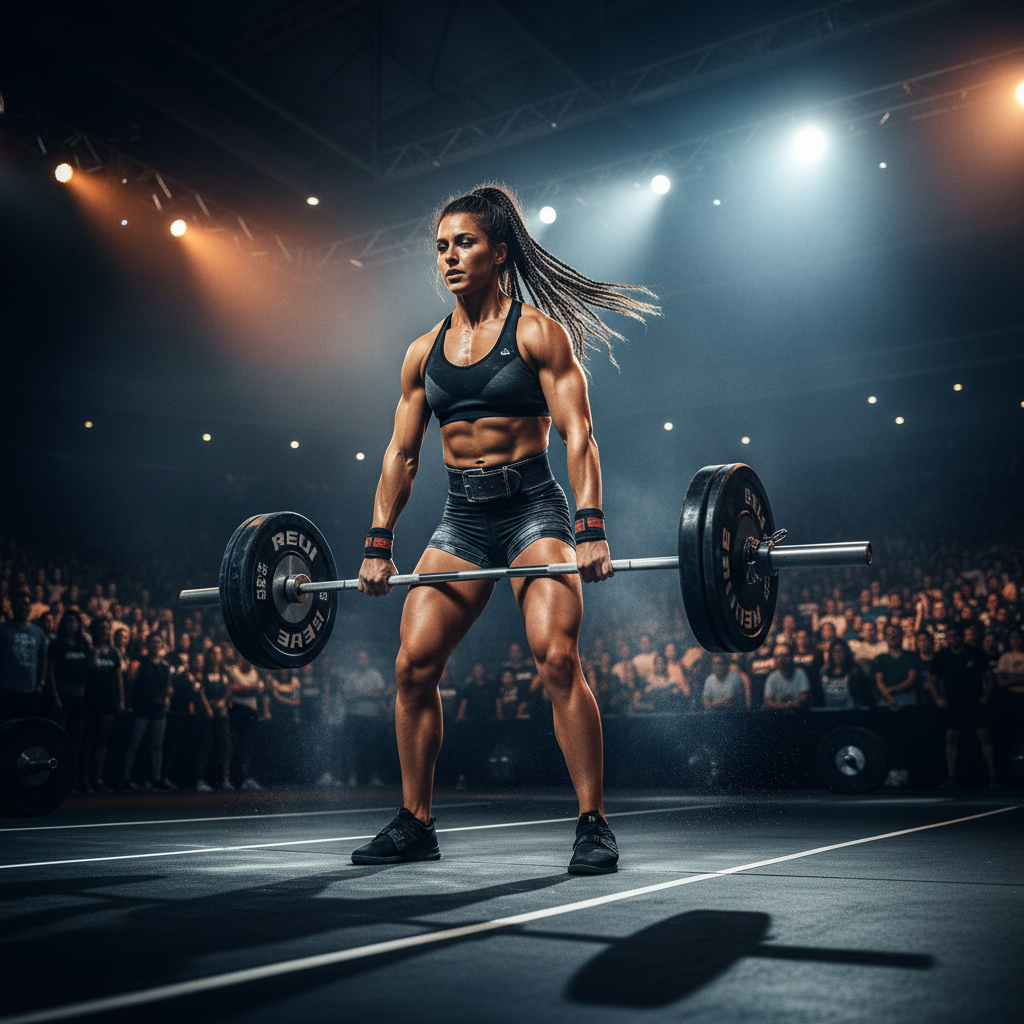
Laura Horvath: The Hunted — Can She Win in 2026?
She has been the best woman at the CrossFit Games for two consecutive years. The question is whether the sport can catch up.
From Hunter to Hunted
There is a moment in every champion's career when the dynamic shifts. When the chase ends and the defence begins. When the athlete who spent years hunting the title must learn to live with a target on their back. Laura Horvath knows this moment. She is living it.
The Hungarian powerhouse won the 2023 CrossFit Games in commanding fashion, climbing from a strong but inconsistent competitor to the undisputed Fittest Woman on Earth. It was the culmination of a journey that began with a stunning runner-up finish at the 2018 Games as a teenager, followed by years of middling results that had the community writing her off.
Nobody is writing her off now. But the landscape around her has changed. In 2026, Horvath is not the hungry underdog anymore. She is the champion — and everyone in the field is training specifically to take what she earned.
"Winning changes everything. The way people look at you. The way they train for you. The way they talk about you. You're no longer chasing — you're being chased." — Laura Horvath
The 2018 Arrival
Horvath's introduction to the CrossFit world remains one of the sport's great debut stories. At just 20 years old, she arrived at the 2018 CrossFit Games as a relative unknown — a Hungarian athlete with minimal international exposure competing against a field that included Tia-Clair Toomey, Katrin Davíðsdóttir, and Annie Thorisdottir.
She finished second.
The performance sent shockwaves through the sport. Horvath was raw, powerful, and fearless — a combination that the establishment found deeply unsettling. Her second-place finish was not the result of strategic racing or careful pacing. She simply outworked athletes who had been doing this for years.
The expectation was immediate: Horvath would be the next dominant champion. The reality was more complicated.
The Wilderness Years
The seasons between 2019 and 2022 were unkind to the narrative of Laura Horvath as an inevitable champion. She finished 13th in 2019. Results varied. Injuries disrupted training cycles. The promise of 2018 seemed increasingly like a flash rather than a forecast.
During this period, Horvath relocated her training from Hungary to CrossFit Reykjavik in Iceland, joining a training environment populated by Games athletes and designed for elite competition preparation. The move was strategic — access to better coaching, training partners, and the competitive culture that Iceland's CrossFit community is famous for.
The results were not immediate, but the foundations were being rebuilt. Horvath's gymnastics improved. Her engine deepened. Her competition strategy matured from "go hard and hope" to something more calculated and sustainable.
The Championship Run: How Horvath Won the Games
Horvath's 2023 Games victory was not a surprise to those who had tracked her trajectory, but it was a revelation to the broader CrossFit community.
The Physical Evolution
Between 2018 and 2023, Horvath underwent a significant physical transformation. Her early career was characterised by raw strength and power — she could lift heavy and cycle fast, but her bodyweight gymnastics and endurance were liabilities at the Games level.
By 2023, those weaknesses had been systematically eliminated:
- ▸Gymnastics: Her bar and ring muscle-ups went from liabilities to weapons
- ▸Running: Her 1-mile time improved by nearly 30 seconds
- ▸Endurance: She demonstrated the ability to maintain performance across all four days of competition
- ▸Consistency: Instead of spiking with event wins and crashing with poor finishes, she delivered top-10 performances on nearly every event
The evolution was the product of five years of deliberate, targeted development — the kind of long-term athlete development that gets lost in a social media culture obsessed with immediate results.
The Tactical Shift
Equally important was Horvath's tactical evolution. The athlete who attacked every event at maximum intensity in 2018 was replaced by a more measured competitor who understood the mathematics of multi-day competition.
At the 2023 Games, Horvath did not win the most individual events. She did not post the single most impressive performance. What she did was eliminate bad finishes. Her worst event placement was still in the top fifteen — a level of consistency that, across 15 scored events, produces a dominant overall performance.
"She didn't win the Games on any single event. She won the Games by never losing it." — Analysis that captures Horvath's 2023 approach
The Moment of Victory
The final event of the 2023 Games is burned into CrossFit memory. Horvath entered the last workout with a comfortable but not insurmountable lead. She did not need to win the event — she needed to not collapse. She did better than that. She competed the final workout with the same intensity and composure that had characterised her entire competition, crossing the finish line with the overall title mathematically secured.
The image of Horvath collapsing on the competition floor, overwhelmed by the realisation that five years of work had finally produced the result she had been chasing since 2018, remains one of the most emotionally powerful moments in Games history.
Defending the Title: The Challenges Ahead
Winning the Games changes an athlete's life. Defending the title changes their psychology. Horvath enters 2026 facing challenges that did not exist when she was the hunter.
The Target Effect
Every serious female competitor in CrossFit is now training with Horvath as the benchmark. Coaches study her competition footage. Athletes identify her weaknesses — however few remain — and develop strategies to exploit them. Programming decisions at Semifinals and the Games may be influenced by the desire to test movements or loading schemes that disadvantage the reigning champion.
This is normal. It happens to every champion. But for Horvath, who spent years developing a style built on chasing, the psychological adjustment to being chased is non-trivial.
The Field Is Deeper
The 2026 competitive field includes multiple athletes capable of winning the Games:
- ▸Gabriela Migała — The Polish athlete has been ascending rapidly, posting progressively better results each season. Her combination of strength and gymnastics makes her a complete competitor.
- ▸Haley Adams — After years as a consistent top-five finisher, Adams has the fitness to win. The question is whether she has the tactical maturity.
- ▸Emma Lawson — The young Canadian has already won a Games title in the Individual competition and represents the new generation's best chance at dethroning Horvath.
- ▸Danielle Brandon — Polarising and powerful, Brandon has the physical tools to beat anyone on any given event. Her challenge is stringing together four consistent days.
- ▸Tia-Clair Toomey — If the six-time champion returns, she immediately becomes the favourite, and Horvath becomes the defender against the greatest of all time.
The Physical Demands of Sustained Excellence
Maintaining peak fitness year after year is one of CrossFit's most underappreciated challenges. The training required to reach the top is brutal. The training required to stay there — while managing the accumulated fatigue, injuries, and psychological weight of elite competition — is even more demanding.
Horvath's training environment at CrossFit Reykjavik provides structural advantages: elite training partners, experienced coaching, and a culture that normalises the daily grind of championship-level preparation. But even the best training environment cannot fully mitigate the physical toll of sustained excellence.
"The hardest part of being champion is not the competition. It's the 50 weeks of training between competitions, knowing that everyone else is working specifically to beat you."
The Hungarian Factor
Horvath's nationality adds a compelling layer to her story. Hungary is not a CrossFit powerhouse. It does not have the affiliate density of the United States, the per-capita dominance of Iceland, or the emerging infrastructure of Scandinavia. Horvath is, in many ways, a singular figure — a world champion from a country that produces few elite CrossFitters.
What She Means to European CrossFit
Horvath's success has had a measurable impact on CrossFit participation in Hungary and Central Europe. Affiliate openings in the region have increased since her Games victory. Youth programmes have launched. Media coverage of CrossFit in Hungarian outlets has expanded from nothing to regular features.
She carries the weight of representation — of showing athletes in smaller CrossFit nations that geography is not destiny. You do not need to be from California or Reykjavik to win the Games. You need talent, coaching, and an almost unreasonable refusal to accept your limitations.
The Reykjavik Connection
Horvath's decision to train in Iceland rather than Hungary is itself a statement about what elite CrossFit competition requires. The move reflected a pragmatic understanding that talent alone is insufficient — environment matters.
At CrossFit Reykjavik, Horvath trains alongside current and former Games athletes in a facility built for elite performance. The daily exposure to world-class competitors pushes her training beyond what would be possible in a less competitive environment.
The partnership with her coaching team — which has been instrumental in the tactical and physical evolution described above — continues to be a cornerstone of her competitive approach.
What Comes Next: The 2026 Season
The 2026 season will define whether Horvath's championship is a singular achievement or the beginning of a dynasty. The difference between a one-time champion and a multi-time champion is enormous — both in legacy and in what it requires psychologically and physically.
The Path Through 2026
Horvath's season will follow the standard competitive path: Open → Quarterfinals → Semifinals → Games. At each stage, she will be the marked athlete, the one every competitor measures themselves against.
The early-season stages are unlikely to challenge Horvath seriously. Her fitness is deep enough to navigate the Open and Quarterfinals without full competitive intensity. The Semifinals will provide the first real test — a chance to gauge her form against the strongest European competitors in a pressure environment.
The Games are where the championship will be decided. Four days. Fifteen-plus events. The accumulated pressure of an entire season compressed into a single weekend in which one bad event can unravel months of preparation.
The Dynasty Question
If Horvath wins the 2026 Games, she enters a conversation with the sport's all-time greats. Back-to-back titles place her alongside Toomey, Fraser, and Froning — athletes who did not just win but dominated across multiple seasons.
If she does not win, the questions will come. Was 2023 a peak? Has the field caught up? Can she adjust and reclaim the title in 2027, or does the window close with each passing season?
Laura Horvath has spent her career proving doubters wrong. At 18, they said she was too young. After 2019, they said she was a one-hit wonder. After years in the middle of the pack, they said she had peaked. She answered every question with a Games title. The 2026 season is the next question. And if history is any guide, betting against Horvath is a losing proposition.
Athlete Profile
Gym Affiliate: CrossFit Glasshouse (formerly trained with Ben Smith) Coach: Various / Self-directed Stats: Height: 5'7" (170cm) | Weight: 154 lbs (70 kg) | Born: March 21, 1997 | Country: Hungary | Also: Olympic Weightlifter (Hungarian national record holder)
Career Competition Results
| Year | CrossFit Games | Semifinal/Regional | Open (Worldwide) |
|---|---|---|---|
| 2018 | 2nd (Rookie of the Year) | 2nd (Europe) | 18th |
| 2019 | 14th (cut Day 3) | — | 234th |
| 2020 | 24th (Stage 1) | 1st (Strength in Depth) | 10th |
| 2021 | 2nd | 2nd (Lowlands Throwdown) | 52nd |
| 2022 | 3rd | 1st (Lowlands Throwdown) | 103rd |
| 2023 | 1st (Fittest on Earth) | 3rd (Europe) | 185th |
| 2024 | Withdrew | 1st (Europe) | 62nd |
Other Major Results
- ▸3x Rogue Invitational Champion (2022, 2023, 2025)
- ▸2023 CrossFit Games Champion — first Hungarian to win
- ▸Withdrew from 2024 Games after Lazar Đukić's death — publicly criticized CrossFit
- ▸Did not compete at 2025 CrossFit Games
- ▸Hungarian National Weightlifting Champion — holds national C&J record (120kg)
- ▸Competed at 2024 World Weightlifting Championships in Bahrain
More from BoxJunkies
Best Lifting Belt for CrossFit 2026: Support That Moves With You
A good lifting belt should become invisible in the middle of a heavy squat or clean. We tested the top CrossFit-compatible lifting belts to find the ones that actually disappear when you need them to.
Best Wrist Wraps for CrossFit 2026: Protect Your Lifts Without Losing Wrist Mobility
Wrist pain is the silent CrossFit career-ender. The right wrist wraps keep you training through heavy pressing cycles and overhead work without sacrificing mobility. Here's our 2026 guide.
TYR CXT-3 Trainer Review: The Underdog CrossFit Shoe That Deserves Your Attention
TYR is known for swimwear. Their CXT-3 training shoe is trying to change that. After 6 weeks of daily CrossFit use, here's whether it's worth taking the leap on an unknown brand.